
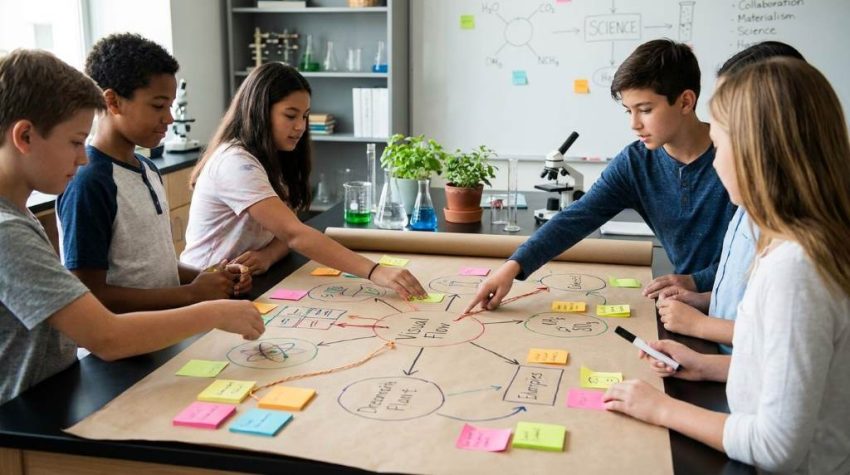
Middle school science classes often challenge students to connect ideas, analyze information, and remember complex concepts. Research from the National Center for Education Statistics shows that students perform better when teachers use visual learning methods in the classroom. In addition, studies reveal that visual organizers can improve comprehension by more than 25% in content-heavy subjects. That is why many educators now explore how to use story mapping in middle school science classes to improve engagement and understanding. Story mapping turns difficult science topics into organized and meaningful learning experiences. As a result, students develop stronger critical thinking skills while enjoying the learning process.
What Is Story Mapping in Science Education?
Story mapping is a visual teaching strategy that organizes information into a structured format. Teachers often use it in reading classes, but it also works extremely well in science instruction. Students break scientific ideas into parts such as cause, effect, process, problem, and solution. This method helps learners understand relationships between scientific concepts more clearly. Consequently, they retain information longer and participate more actively during lessons.
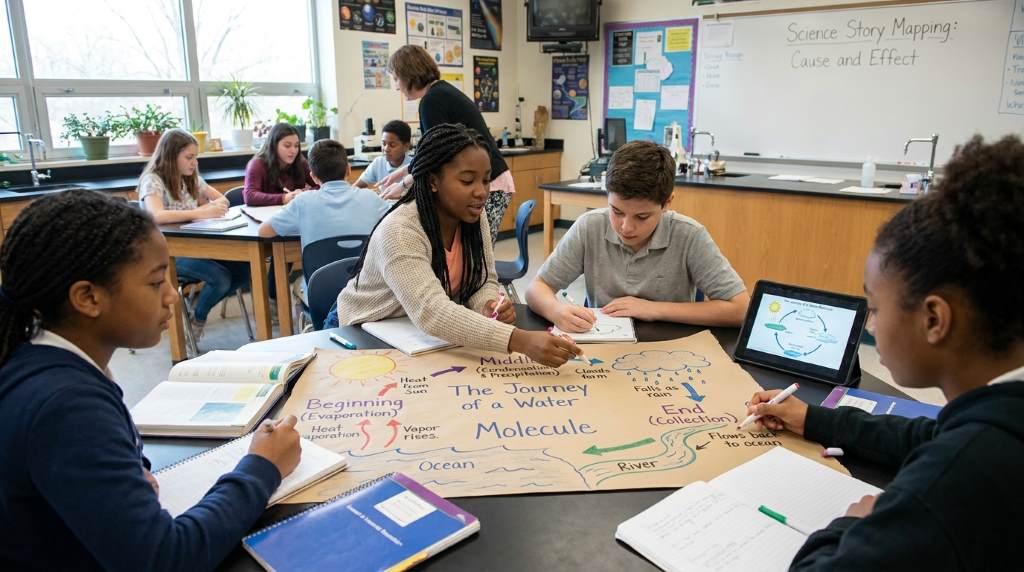
Science teachers can use story maps to explain experiments, ecosystems, scientific discoveries, and the scientific method. For example, students can create a story map about the water cycle by identifying stages, causes, and outcomes. This process encourages logical thinking and stronger comprehension skills. Furthermore, story mapping supports visual learners who struggle with traditional note-taking methods. Teachers interested in better instructional strategies can also explore art science of pedagogy approaches for broader classroom improvement.
Why Story Mapping Works in Middle School Science
Middle school students often lose focus when science lessons become too technical or text-heavy. Story mapping simplifies difficult information into smaller and manageable sections. Students can visually follow processes and relationships instead of memorizing isolated facts. As a result, classroom participation and confidence increase naturally. This method also encourages collaborative learning among students.
Teachers who understand how to use story mapping in middle school science classes often notice better comprehension and classroom discussions. Story maps support inquiry-based learning because students actively organize and interpret information. In addition, visual structures reduce confusion during complex science topics like energy transfer or ecosystems. Students also improve problem-solving abilities through organized thinking. Therefore, story mapping becomes an effective classroom strategy for long-term academic growth.
Benefits of Story Mapping in Science Classes
Story mapping offers several advantages for both teachers and students in middle school science classrooms. It improves organization while making lessons more interactive and student-centered. Moreover, students become more confident when they can visually track scientific ideas. Teachers also gain a clearer view of student understanding during class activities. These benefits create a stronger and more engaging learning environment.
- Improves science vocabulary retention
- Encourages active classroom participation
- Strengthens critical thinking skills
- Supports visual and struggling learners
- Helps students organize scientific processes
- Makes science lessons more memorable
Story mapping also supports differentiated instruction for students with varying learning abilities. Some learners process information faster through diagrams than written explanations. Additionally, visual mapping reduces cognitive overload during difficult lessons. Students who struggle with lengthy textbook readings often benefit the most from this method. Therefore, story mapping promotes inclusivity in science education.
How to Use Story Mapping in Middle School Science Classes Effectively
Teachers should begin with simple science topics before moving to advanced concepts. Introducing story mapping gradually allows students to understand the process without feeling overwhelmed. First, explain the purpose of the map and model how to complete one together. Then, encourage students to practice independently or in groups. This step-by-step approach builds confidence and consistency in the classroom.
Teachers can use story mapping during experiments, lab activities, or chapter reviews. For example, students can map out the stages of photosynthesis using sections for inputs, process, and outcomes. Similarly, teachers can assign maps after science videos or reading assignments. This technique encourages deeper understanding instead of surface-level memorization. Educators who focus on classroom engagement may also benefit from social emotional activities that support collaborative learning.
Use Story Maps Before a Lesson
Teachers can introduce a partially completed story map before beginning a science lesson. This strategy activates prior knowledge and prepares students for new concepts. Students begin identifying key ideas before diving into detailed instruction. Consequently, they remain more focused throughout the lesson. This method also creates stronger lesson structure and organization.
Use Story Maps During Experiments
Science experiments become easier to understand when students visually track each step. Teachers can ask students to document hypotheses, procedures, observations, and conclusions using a story map. This process improves scientific reasoning and accountability during lab work. In addition, students learn to organize information logically and clearly. As a result, lab reports often become more accurate and detailed.
Use Story Maps for Review Sessions
Review sessions can feel overwhelming when students must remember multiple science concepts at once. Story maps help simplify review activities into manageable visual summaries. Students can compare ideas, connect lessons, and identify gaps in understanding more easily. Furthermore, group review activities become more interactive and engaging. This approach improves test preparation without adding unnecessary stress.
Best Science Topics for Story Mapping
Some science topics naturally fit story mapping because they involve sequences, relationships, or processes. Teachers should prioritize lessons that require step-by-step understanding or cause-and-effect analysis. Students often understand these topics faster through visual organization methods. In addition, story maps help learners connect scientific details more effectively. This creates stronger comprehension across multiple science units.
- The water cycle
- Photosynthesis
- Food chains and ecosystems
- The scientific method
- Weather systems
- Human body systems
- States of matter
- Energy transformation
Teachers can also adapt story mapping for STEM projects and inquiry-based learning activities. For example, students can map engineering challenges by outlining problems, solutions, and results. This method encourages creativity while maintaining scientific structure. Additionally, students become more comfortable explaining scientific reasoning verbally and visually. Therefore, story mapping supports multiple learning objectives at the same time.
Digital Tools for Story Mapping in Science
Technology has made story mapping easier and more interactive for middle school classrooms. Many digital platforms allow students to create colorful and organized visual maps quickly. Teachers can integrate these tools during classroom instruction or remote learning activities. Furthermore, digital maps make collaboration easier among students. This flexibility increases student engagement and participation.
Popular tools include Google Drawings, Canva, Lucidchart, and MindMeister. These platforms offer templates that simplify the mapping process for beginners. Students can also add images, arrows, diagrams, and labels to strengthen understanding. As a result, science lessons become more creative and memorable. Teachers working with diverse learners may also appreciate strategies from adapt universal elementary education resources for inclusive instruction.
Common Mistakes Teachers Should Avoid
Some teachers overload story maps with too much information, which creates confusion instead of clarity. Middle school students need simple and visually organized layouts to stay focused. Teachers should avoid turning story maps into lengthy writing assignments. Instead, they should encourage concise points and visual connections. This keeps the activity engaging and effective.
Another common mistake involves using the same map format for every lesson. Students may lose interest if activities become repetitive over time. Teachers should vary map structures based on lesson goals and student needs. Additionally, educators should provide examples before expecting independent student work. Clear guidance improves confidence and classroom success significantly.
Tips to Make Story Mapping More Engaging
Creative activities can make story mapping more exciting for middle school students. Teachers can allow students to use colors, symbols, and illustrations during mapping exercises. Group competitions and collaborative projects also increase motivation and participation. Moreover, students enjoy sharing their completed maps with classmates. This creates a more dynamic classroom environment.
Teachers can also connect science story maps to real-world situations and current events. For example, students can map the causes and effects of pollution or climate change. These activities make science more relevant and meaningful for learners. Additionally, students become better at applying scientific knowledge outside the classroom. Therefore, story mapping supports both academic and practical learning goals.
How Story Mapping Supports Different Learning Styles
Every classroom contains students with different learning preferences and academic strengths. Story mapping helps visual learners by presenting information through diagrams and structured layouts. Auditory learners benefit when students discuss and explain their maps during class activities. Meanwhile, kinesthetic learners engage through hands-on creation and organization tasks. This flexibility makes story mapping valuable for diverse classrooms.
Students with learning difficulties often experience less frustration when information appears visually organized. Story maps reduce the pressure of processing large amounts of text at once. In addition, students develop stronger confidence when they can clearly follow scientific concepts. Teachers also gain insight into student understanding through completed maps. Consequently, instruction becomes more targeted and effective.
Conclusion
Understanding how to use story mapping in middle school science classes can transform the learning experience for both students and teachers. This strategy simplifies complex science concepts while improving organization, engagement, and critical thinking. Students become more active participants because they can visually connect scientific ideas and processes. In addition, story mapping supports different learning styles and encourages deeper comprehension. Start using story mapping in your science classroom today to create more engaging and meaningful learning experiences for your students while exploring innovative teaching ideas through multilingual classroom strategies.
FAQs
What is story mapping in science classes?
Story mapping is a visual strategy that helps students organize scientific concepts and processes clearly.
Why is story mapping important for middle school students?
It improves comprehension, critical thinking, and student engagement during science lessons.
Can story mapping help struggling learners?
Yes, story mapping simplifies information and supports visual learning for struggling students.
What science topics work best with story mapping?
Topics like ecosystems, photosynthesis, weather systems, and experiments work especially well.
Are digital story mapping tools useful in classrooms?
Yes, digital tools make story mapping more interactive, collaborative, and visually appealing.