

Online education has grown at a remarkable pace over the last decade. Millions of students now learn from home, from offices, and from remote corners of the world. However, many of them still struggle to stay engaged. They watch videos, read slides, and then forget most of what they learned a week later. This is a real problem. Fortunately, immersive learning offers a powerful solution.
This article walks you through what immersive learning is, why it works, and exactly how educators and institutions can apply it in online education to get better results.
What Is Immersive Learning?
Immersive learning is an approach that places the learner inside the experience rather than outside it. Instead of passively reading or watching, learners actively participate. They make decisions, face consequences, and engage with content in a way that feels real and meaningful.
Think of a flight simulator. Pilots do not learn to fly by only reading manuals. They sit in a cockpit, feel the controls, and respond to real-time scenarios. Immersive learning brings that same energy into digital education. It uses tools like simulations, virtual reality, storytelling, and scenario-based exercises to create deep engagement.
Additionally, research consistently shows that people retain far more information when they learn by doing. The brain connects better to experiences than to facts presented on a screen.
Why Traditional Online Courses Often Fall Short
Most online courses follow a simple pattern. A learner watches a video, reads some text, takes a quiz, and moves on. This works for basic knowledge transfer. However, it rarely builds the kind of deep understanding that changes behavior or sharpens real-world skills.
There are a few key reasons why this happens.
First, passive learning does not activate the emotional centers of the brain. Emotion plays a big role in how we store and recall memories. When a learner feels nothing, they often remember nothing.
Second, traditional courses lack personal relevance. A module about workplace communication is easy to ignore when it has no connection to your actual job or daily challenges.
Third, there is no real pressure or stakes. Without consequences for wrong answers, learners have little motivation to think carefully.
Immersive learning addresses all three of these problems directly.
Core Principles Behind Effective Immersive Learning
Before applying any specific technique, it helps to understand the principles that make immersive learning work.
Active participation is the first principle. Learners must do something, not just consume content. Every activity should require a decision, a response, or a creative output.
Contextual relevance is the second principle. The learning environment should mirror real situations the learner will actually face. When content feels relevant, motivation goes up naturally.
Feedback and reflection form the third principle. Learners need to know when they are right and why they are wrong. Thoughtful feedback after each activity creates a loop that builds stronger understanding over time.
Finally, emotional connection ties everything together. Stories, characters, and challenges that feel real create the emotional engagement the brain needs to encode long-term memories.
Practical Ways to Apply Immersive Learning in Online Education
Use Scenario-Based Learning Modules
Scenario-based learning is one of the most accessible ways to bring immersive learning into any online course. Instead of presenting facts, you present a situation. The learner reads or watches a brief scenario and then makes a choice. Each choice leads to a different outcome.
For example, a course on customer service might present a difficult client interaction. The learner chooses how to respond. If they choose poorly, the scenario shows the unhappy client leaving. If they choose well, they see a satisfied customer and learn why the response worked.
This approach keeps learners actively thinking. It also gives them a safe space to make mistakes and learn from them without real-world consequences. Therefore, retention improves significantly.
Incorporate Simulations and Virtual Labs
Simulations allow learners to practice complex skills in a controlled environment. Medical students can practice diagnosing patients. Engineering students can test designs. Business students can run virtual companies.
You do not need expensive technology to create simulations. Many platforms offer simple drag-and-drop tools to build interactive exercises. Even a well-designed spreadsheet exercise that mimics a real business problem counts as a form of simulation.
Virtual labs are especially useful in science and technology education. They let students conduct experiments, observe results, and draw conclusions without needing physical equipment. Additionally, they can repeat experiments as many times as needed, which deepens understanding.
Leverage Storytelling and Narrative Arcs
Stories are one of the oldest and most effective learning tools in human history. When you wrap educational content inside a compelling narrative, learners pay closer attention. They want to know what happens next.
You can apply storytelling in online education by creating a central character who faces challenges related to the course content. As the course progresses, the character grows, solves problems, and develops skills. The learner grows alongside them.
This works well in professional development courses, leadership training, and soft skills education. However, it can be adapted for nearly any subject with some creative thinking.
Add Game Elements to Your Course Design
Gamification is not about turning education into a video game. It is about borrowing motivational structures from games and applying them to learning. Points, badges, leaderboards, and progress bars all tap into the brain’s reward systems.
However, the most powerful game element is challenge with purpose. When a learner faces a difficult problem that requires real thinking, and then solves it, they experience a genuine sense of achievement. That feeling drives them to keep going.
You can design challenges as timed activities, puzzle-style problems, or competitive team exercises. The key is to make the difficulty appropriate. Too easy and learners get bored. Too hard and they give up. Therefore, always design challenges that stretch learners just beyond their current comfort zone.
Use Collaborative and Social Learning Activities
Learning alongside others adds a layer of immersion that solo activities cannot provide. When learners discuss ideas, debate solutions, and teach each other, they engage more deeply with the material.
Online discussion forums, group projects, peer review assignments, and live virtual workshops all support collaborative learning. These activities work best when they are structured around real problems or case studies.
Additionally, social learning builds accountability. When a learner knows that classmates are waiting on their contribution, they are more likely to prepare and participate fully.
Integrate Virtual Reality and 360-Degree Video
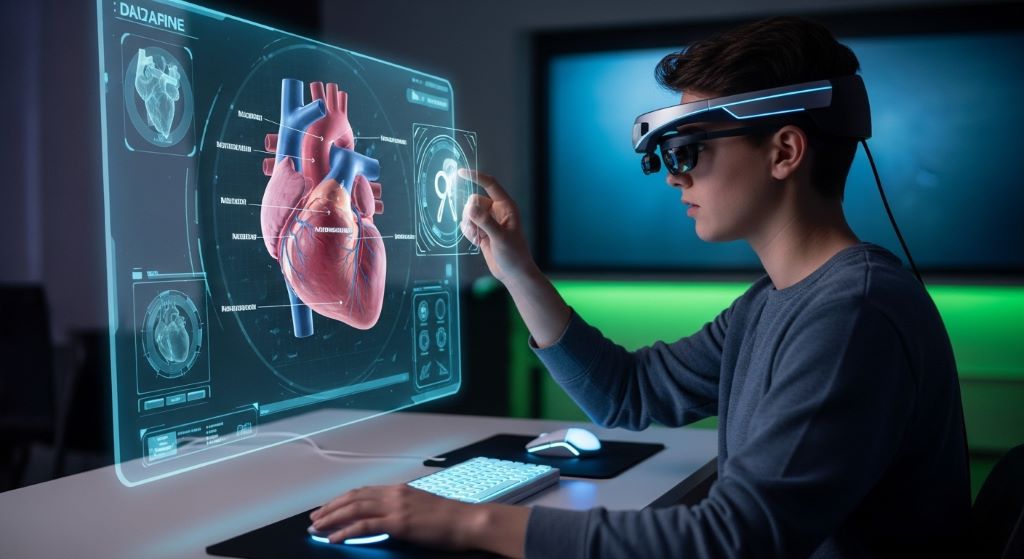
For institutions with more resources, virtual reality offers one of the most powerful forms of immersive learning available today. Learners can walk through historical events, explore the human body, or practice high-stakes conversations in realistic environments.
360-degree video is a more accessible entry point. It places the viewer inside a real location or scenario and allows them to look around freely. A nursing course might use 360-degree video to simulate a hospital ward. A hospitality course might tour a busy hotel kitchen during peak service.
Even without VR headsets, these videos work in a browser and offer a meaningful step up from traditional video content.
How to Measure the Impact of Immersive Learning
Applying immersive learning is only half the job. You also need to measure whether it is actually working. Here are a few practical ways to do that.
Track completion rates. Immersive courses tend to see higher completion rates than passive ones. If your numbers improve after redesigning a course, that is a positive signal.
Assess knowledge transfer. Test learners not just on what they remember, but on whether they can apply knowledge in new situations. Scenario-based assessments work well for this.
Gather learner feedback. Ask learners how engaging and relevant they found the experience. Short surveys at the end of each module give you useful data quickly.
Observe behavioral change. For professional training programs, the ultimate goal is to see new behaviors on the job. Work with managers or team leaders to track whether course content is actually being applied.
Common Mistakes to Avoid
Many educators make a few common errors when introducing immersive learning into their courses. Knowing these in advance saves time and resources.
Adding interactivity without purpose is a frequent mistake. Clicking through animations or dragging items around a screen feels interactive but may teach nothing. Every interactive element should serve a clear learning goal.
Overloading learners with complexity is another pitfall. Immersive learning works best when it is focused. Trying to teach too many things at once through a single simulation or scenario confuses learners and reduces retention.
Neglecting accessibility is also a serious concern. Make sure that all immersive content works for learners with disabilities. This includes providing captions for video content, alt text for images, and keyboard navigation for interactive elements.
Getting Started Without a Big Budget
You do not need a large team or a large budget to begin applying immersive learning in your online courses. Many free or low-cost tools make it easier than ever.
Tools like H5P, Articulate Rise, and Adobe Captivate allow educators to build scenario-based and interactive content with relatively little technical skill. Google Forms can simulate branching scenarios. Simple video editing tools can create engaging narrative content.
Start small. Redesign one module or one lesson using the principles described above. Measure the results. Then expand from there. A thoughtful, incremental approach tends to produce better long-term outcomes than a rushed overhaul.
Conclusion
Immersive learning is not a trend. It is a well-supported approach to education that aligns with how the human brain actually learns. By moving learners from passive observers to active participants, online educators can dramatically improve engagement, retention, and real-world application of skills.
The key steps are simple to understand, even if they take effort to implement well. Use scenarios that mirror real situations. Build in simulations where practice is possible. Tell stories that create emotional connection. Add game elements that motivate without distracting. Encourage collaboration. And always measure your results so you can keep improving.
Online education has enormous potential. With immersive learning principles guiding your design choices, that potential becomes real, measurable results for every learner you serve.
Frequently Asked Questions
What is the difference between immersive learning and e-learning?
E-learning is a broad term for any learning delivered digitally. Immersive learning is a specific approach within e-learning that emphasizes active participation, realistic scenarios, and emotional engagement. Not all e-learning is immersive, but immersive learning always uses digital tools to create deeply engaging experiences.
Do I need virtual reality technology to implement immersive learning?
No. Virtual reality is one tool within the immersive learning toolkit, but it is not required. Scenario-based modules, simulations, storytelling, and gamification can all create immersive experiences without any VR hardware. Many effective immersive courses run entirely in a standard web browser.
How long does it take to build an immersive online course?
The time varies depending on the complexity of the content and the tools you use. A simple scenario-based module might take a few days to build. A full simulation or branching narrative course could take several weeks or months. Starting with one redesigned lesson helps you learn the process before scaling up.
Is immersive learning suitable for all age groups?
Yes, with appropriate adjustments for each audience. Young learners benefit from game-like elements and short, story-driven activities. Adult learners respond well to real-world scenarios tied to their professional lives. The core principles of active participation and contextual relevance apply across all age groups.
How can I measure whether immersive learning is actually improving outcomes?
Use a combination of completion rates, knowledge assessments, learner satisfaction surveys, and behavioral observation after the course ends. Comparing these metrics before and after redesigning a course gives you clear evidence of impact. For workplace training, follow up with managers to see if skills are being applied on the job.
Related Topics:
How to Create a Personal Education Plan That Matches Your Career Goals
Study Techniques for Students with ADHD: Practical Tips for Better Focus and Learning