
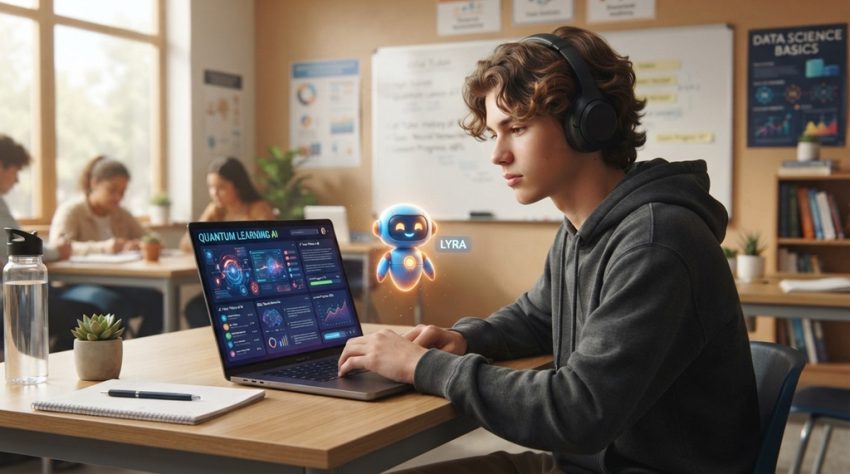
AI in the classroom is changing how students learn, how teachers teach, and how schools operate. It personalizes lessons for each student’s pace. It also automates grading, which gives teachers more time to teach. Plus, it helps spot struggling students before they fall behind.
This shift isn’t science fiction anymore. In fact, schools and universities already use AI tools every day. For example, teachers use them to plan lessons, while students use them to study smarter, not just harder.
So, in this article, we’ll break down exactly how AI is reshaping education right now. We’ll cover real classroom uses, the challenges schools face, and what this means for students and teachers going forward.
What Does AI in the Classroom Actually Mean?
AI in the classroom refers to software and tools that use machine learning to support teaching and learning. These tools don’t replace teachers. Instead, they help with tasks like grading, tutoring, and building personalized learning paths.
Some common examples include:
- Adaptive learning platforms that adjust difficulty based on how a student performs
- AI tutoring chatbots that answer questions outside class hours
- Automated grading tools that score essays and quizzes right away
- Plagiarism and writing assistants that check originality and grammar
- Predictive analytics that flag students at risk of falling behind
Together, these tools solve specific classroom problems and create a more responsive learning space.
How AI Personalizes Learning for Each Student
AI personalizes education by adjusting content to match each student’s skill level and pace. In a typical classroom, teachers often teach at one fixed speed. As a result, this leaves faster learners bored and slower learners overwhelmed.
Adaptive Learning Paths
Adaptive platforms track how a student answers questions. So, if a student struggles with fractions, the system offers more practice problems. On the other hand, if a student learns a concept quickly, it moves them ahead. This way, every learner stays properly challenged.
Customized Study Recommendations
AI tools also suggest specific resources based on performance data. For instance, a student who struggles with essay structure might get targeted writing exercises. Overall, this focused approach saves study time and builds confidence faster than generic worksheets.
According to industry experts, personalized learning models can boost student engagement compared to one-size-fits-all teaching. Still, the exact impact varies by subject and student, but the shift toward personalization is clear.
AI-Powered Tutoring and Homework Help
AI tutoring tools give students on-demand academic support outside regular school hours. Many students get stuck on homework at night when teachers aren’t around. That’s where AI chatbots step in.
These tools can:
- Explain math problems step-by-step
- Answer questions about reading assignments
- Offer practice quizzes on demand
- Give instant feedback on written work
Thanks to this, students no longer need to wait until the next class to get help. This quick feedback loop helps ideas stick better than delayed explanations do.
That said, relying too heavily on AI tutors carries some risk. Students still need to build independent problem-solving skills. In other words, smart use means treating AI as a study partner, not a shortcut.
How AI Helps Teachers Save Time
Teachers spend hours grading papers, planning lessons, and tracking student progress. Fortunately, AI automates many of these repetitive tasks, which frees up time for actual teaching.
Automated Grading and Feedback
AI grading tools can score multiple-choice tests instantly. Newer tools can even review short essays for grammar, structure, and clarity. Of course, this doesn’t replace a teacher’s final judgment, but it does speed up the first pass a lot.
Smarter Lesson Planning
Likewise, AI can generate lesson plan drafts based on curriculum standards. From there, teachers customize these drafts to fit their classroom needs. Because of this, planning time drops, and teachers get more room to try creative lesson formats.
Early Warning Systems for At-Risk Students
Predictive tools flag students who show signs of falling behind. Warning signs like dropped attendance, missed assignments, and falling quiz scores all count. As a result, teachers can step in earlier, often before a student’s grades fully collapse.
Key Challenges of AI Integration in Modern Education
The implementation of artificial intelligence in schools offers unprecedented personalization, yet it introduces critical ethical hurdles—ranging from algorithmic bias and data privacy concerns to the potential erosion of foundational critical thinking. Overcoming these obstacles requires deliberate strategies from educators, parents, and learners to ensure technology enhances rather than replaces authentic comprehension. When managed responsibly alongside the best AI tools for students in 2026 (Free & Paid), machine learning effectively tailors daily study routines, streamlines complex research, and elevates student performance without compromising academic integrity.
Academic Integrity Concerns
Some students misuse AI writing tools to finish assignments dishonestly. In response, schools now use AI detection software to catch this, though it isn’t always accurate. Ultimately, clear school policies matter more than the technology itself.
Data Privacy Risks
AI platforms collect data on student performance, behavior, and sometimes personal details. Because of this, parents and schools need transparency about how that data gets stored and used. Unfortunately, not every platform handles this responsibly.
Unequal Access
Not all schools have equal funding for AI tools or steady internet access. This creates a gap between well-funded schools and under-resourced ones. For this reason, equity remains one of the biggest unsolved issues in AI education.
Reduced Critical Thinking Risk
Leaning too much on AI for answers can weaken a student’s ability to think independently. Instead, the goal should be AI-assisted learning, not AI-dependent learning. Here, teachers play a key role in setting healthy limits.
A Practical Angle Most Articles Miss: The “AI Study Stack” Approach

Most articles list AI tools one by one. Few, however, explain how students should actually combine them into a routine. So here’s a simple framework students can use.
Rather than using one AI tool for everything, try building a small “study stack” with clear roles:
- One tool for concept explanation — use it when you’re stuck on a topic, not to write your work for you.
- One tool for practice and quizzing — use it to test recall after you’ve studied, not before.
- One tool for writing feedback only — use it to check grammar and clarity, never to create original content for submission.
This separation helps prevent over-reliance on a single tool. It also builds a habit of using AI as a feedback loop rather than an answer machine. In fact, students who set up their AI use this way tend to remember information better than those who treat AI like a generic search engine for answers.
What the Future of AI in the Classroom Looks Like
Going forward, AI in education will likely become more built-in, not more separate. Instead of standalone apps, AI features will get added directly into the learning platforms schools already use.
Soon, we may see more voice-based AI tutors, real-time translation for multilingual classrooms, and AI-assisted support for special education. Meanwhile, teachers will likely spend less time on admin tasks and more time on direct student interaction.
Even so, the technology will keep evolving. The core goal, however, should stay the same: help students learn better, not just faster.
Frequently Asked Questions
Is AI replacing teachers in the classroom?
No, AI is not replacing teachers. Instead, it automates repetitive tasks like grading and helps generate lesson plan drafts. Teachers still handle instruction, mentorship, and classroom management, which AI cannot replicate.
Can AI tools help students with learning disabilities?
Yes, many AI tools offer text-to-speech, simpler explanations, and adaptive pacing. Because of these features, they can help students with learning disabilities like dyslexia or ADHD. In fact, schools increasingly use AI to support individualized education plans.
Is it cheating to use AI for homework?
It depends on how it’s used and what your school’s policy says. Generally, using AI to understand a concept is fine, while using it to write an entire assignment for submission is not. So, always check your teacher’s guidelines first.
How accurate is AI grading compared to human teachers?
AI grading works well for objective content like multiple-choice tests and basic math. For subjective work like essays, though, it’s improving but still benefits from a teacher’s final review. Most schools, therefore, use AI grading as a first pass, not a final decision.
What age group benefits most from AI learning tools?
AI tools benefit students of every age group, but the format changes. Younger students benefit most from simple, game-like adaptive learning. Older students and college learners, on the other hand, benefit more from AI tutoring and writing feedback tools.
Conclusion
In short, AI in the classroom is transforming learning by personalizing lessons, automating teacher workloads, and offering students on-demand support. It isn’t a replacement for teachers; rather, it’s a tool that, when used well, makes learning more responsive and efficient.
Still, real challenges remain around privacy, equity, and academic integrity. Because of this, schools, teachers, and students all share a role in using AI responsibly. When used well, AI can make classrooms smarter without making students more dependent on it.