

Learning how to remember information quickly can transform your academic performance. However, most students rely on outdated methods that waste time and energy. Therefore, understanding the science behind memory encoding can help you study smarter, not harder.
Memory encoding is the process your brain uses to convert information into a format that can be stored and retrieved later. Additionally, research shows that certain techniques can dramatically improve how quickly and effectively you encode new information. In this article, you’ll discover three powerful yet underutilized strategies that can revolutionize your study sessions.
Understanding Memory Encoding and Why It Matters
Before diving into specific techniques, it’s important to understand what memory encoding actually means. Your brain doesn’t simply record information like a camera. Instead, it actively transforms sensory input into meaningful patterns that connect with existing knowledge.
The encoding process happens in three main stages. First, your brain perceives the information through your senses. Next, it processes and organizes this data. Finally, it stores the information in long-term memory. However, not all encoding is equally effective.
Strong encoding creates multiple pathways to retrieve information later. Therefore, the techniques you use during study sessions directly impact how well you’ll remember the material during exams. Moreover, effective encoding reduces the number of review sessions you’ll need before achieving mastery.
According to research from Harvard Medical School, active engagement with material creates stronger neural connections than passive reading. This understanding forms the foundation of the three secret techniques discussed below.
Secret Tip 1: The Elaborative Interrogation Method
Most students read their notes passively. However, the elaborative interrogation method transforms you from a passive receiver into an active questioner. This technique involves constantly asking yourself “why” and “how” questions about the material you’re studying.
When you encounter a new concept, don’t just accept it at face value. Instead, ask yourself why this information is true. For example, if you’re learning that photosynthesis produces oxygen, ask why plants release oxygen specifically. Then, connect this to what you already know about cellular respiration and the carbon cycle.
This approach works because it forces your brain to create meaning from the information. Additionally, it builds bridges between new material and existing knowledge structures. Therefore, you create a web of interconnected ideas rather than isolated facts.
To implement this technique effectively, follow these steps during your study sessions. First, read a paragraph or concept from your textbook. Next, close the book and explain why that information is true in your own words. Then, identify connections to other topics you’ve studied. Finally, write down any questions that arise and seek answers immediately.
The power of elaborative interrogation lies in its ability to deepen processing. However, it requires more effort than simple rereading. Nevertheless, students who use this method consistently report better retention and understanding of complex material.
Secret Tip 2: Dual Coding with Strategic Visualization
Your brain processes visual and verbal information through different channels. Therefore, combining both creates redundant encoding that strengthens memory. This principle, known as dual coding, remains one of the most underutilized study strategies.
Dual coding doesn’t mean simply looking at pictures in your textbook. Instead, it involves actively creating visual representations of verbal information. For instance, when studying historical events, create a timeline with small sketches representing key moments. When learning biological processes, draw diagrams that show the sequence of steps.
The secret lies in creating your own visualizations rather than copying existing ones. This active creation process forces deeper engagement with the material. Additionally, personalized images are more memorable because they reflect your unique understanding and associations.
To master dual coding, start small. Pick one concept from your current study material. Then, spend five minutes creating a visual representation without looking at any existing diagrams. Your drawing doesn’t need artistic merit. However, it should capture the essential relationships and processes.
Furthermore, you can extend this technique by adding color coding to your visualizations. Different colors can represent different categories, time periods, or importance levels. Moreover, adding movement or arrows to show processes or cause-and-effect relationships creates dynamic mental models.
Research confirms that students who combine verbal and visual learning strategies perform significantly better on both immediate and delayed tests. Therefore, investing time in dual coding pays substantial dividends.
Secret Tip 3: Distributed Practice with Deliberate Intervals
Cramming might seem efficient, but it creates weak encoding that fades quickly. Instead, distributed practice spaces your study sessions across time, allowing your brain to consolidate information between sessions. However, the secret isn’t just spacing out practice but doing so strategically.
The spacing effect occurs because your brain strengthens memories each time you successfully retrieve them. Additionally, struggling slightly to recall information actually enhances encoding. Therefore, optimal spacing creates desirable difficulty where retrieval requires effort but remains achievable.
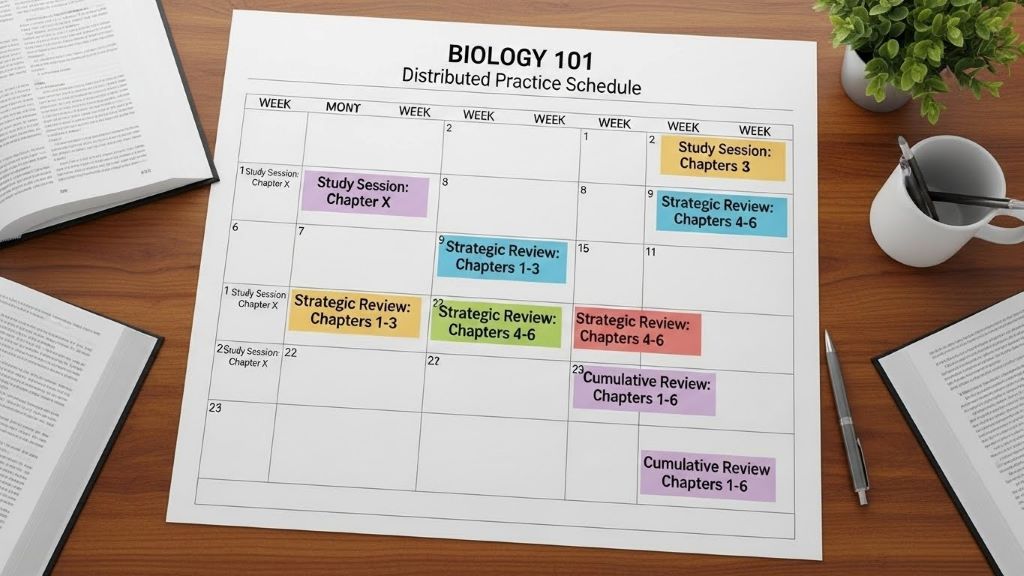
Most students spread practice randomly. However, research suggests specific intervals work best. Start by reviewing new material after one day. Then, review again after three days. Next, review after one week. Finally, review after two weeks and then monthly.
This expanding interval approach matches how memory naturally decays. Initially, forgetting happens quickly, so you need shorter intervals. However, as memories strengthen, you can extend the time between reviews. Moreover, this system ensures you invest study time where it’s most needed.
To implement distributed practice effectively, create a review calendar at the start of each unit. Mark specific dates for reviewing each topic based on when you first learned it. Additionally, use flashcard apps that incorporate spaced repetition algorithms to automate this process.
Furthermore, combine distributed practice with active recall. Don’t simply reread your notes during review sessions. Instead, test yourself by writing everything you remember about a topic before checking your materials. This retrieval practice creates stronger encoding than passive review.
The challenge with distributed practice is that it requires planning and discipline. However, students who adopt this approach consistently outperform those who study the same total hours using massed practice. Therefore, the investment in organizing your schedule pays significant returns.
Combining These Techniques for Maximum Impact
While each technique is powerful alone, combining them creates synergistic effects. For example, during your initial study session, use elaborative interrogation to deeply process the material. Then, create visual representations using dual coding to encode the information through multiple channels. Finally, schedule distributed practice sessions to strengthen these encodings over time.
Additionally, vary which techniques you emphasize during different review sessions. Your first encounter with material might focus heavily on elaborative interrogation and dual coding. However, later reviews might emphasize pure recall with minimal cues. This variation creates additional encoding pathways.
Moreover, adjust these techniques based on the type of material you’re studying. Conceptual subjects like psychology or history benefit greatly from elaborative interrogation. Meanwhile, procedural knowledge like mathematics gains more from worked examples combined with distributed practice. Therefore, remain flexible in your application.
Conclusion
Effective memory encoding doesn’t require endless hours of study. Instead, it demands strategic techniques that align with how your brain naturally processes and stores information. The three secret tips covered in this article, elaborative interrogation, dual coding, and distributed practice, represent evidence-based approaches that can dramatically improve your learning efficiency.
By asking deeper questions about the material you’re studying, you create meaningful connections that enhance retention. Additionally, combining verbal and visual learning through dual coding provides multiple retrieval pathways. Furthermore, spacing your practice strategically allows proper memory consolidation while minimizing wasted effort.
These techniques require more active engagement than passive reading or highlighting. However, the time you invest in applying them properly will be repaid many times over through improved grades, deeper understanding, and longer-lasting knowledge. Therefore, start implementing these strategies today and experience the difference they make in your academic performance.
Frequently Asked Questions
How long should I spend on each study session using these techniques?
Optimal study sessions last between 25 to 50 minutes, followed by a short break. This duration allows for deep focus without mental fatigue. Additionally, shorter, focused sessions using these active techniques prove more effective than longer, passive ones. Therefore, aim for multiple quality sessions rather than marathon study periods.
Can these memory encoding techniques work for all subjects?
Yes, these techniques are versatile and applicable across subjects. However, you may need to adapt them slightly. For example, mathematics benefits from worked examples combined with distributed practice, while history might emphasize elaborative interrogation more heavily. Therefore, experiment to find the right balance for each subject.
How quickly will I see results from using these study methods?
Most students notice improved recall within one to two weeks of consistent application. However, the full benefits emerge over a semester as you build stronger foundational knowledge. Additionally, these techniques create compounding advantages, where earlier material learned well supports faster acquisition of new concepts.
Do I need to use all three techniques together, or can I use them separately?
While combining techniques creates the strongest results, each method provides benefits independently. If you’re just starting, focus on mastering one technique first. Then, gradually incorporate the others as they become habitual. However, distributed practice should be your foundation regardless, as it affects when you study rather than how.
What if I’ve already studied using traditional methods? Should I restart with these techniques?
You don’t need to restart completely. Instead, apply these techniques during your review sessions for material you’ve already covered. Use elaborative interrogation to deepen your understanding, create visual representations to add new encoding pathways, and organize distributed practice sessions. Therefore, you can enhance existing knowledge while building better habits for new material.
Related Topics:
Building Career Blueprint: A Comprehensive Guide to Crafting a Successful Professional Journey
How to Be More Productive in Studies: Mastering Effective Strategies for Academic Success